
Drive rolls are the mechanism that actually pushes wire through everything downstream of the feeder, and when they’re wrong for the wire or worn past their service life, the symptom looks identical to a generic “feed problem.” Getting the push side right is a separate question from what’s happening upstream in the conduit, and the two get confused often enough that it’s worth drawing the line clearly.
This page covers drive roll selection by wire type, tension calibration, common wear symptoms, and how to tell a drive roll problem apart from a conduit problem before replacing the wrong part.
What drive rolls do, and the main types
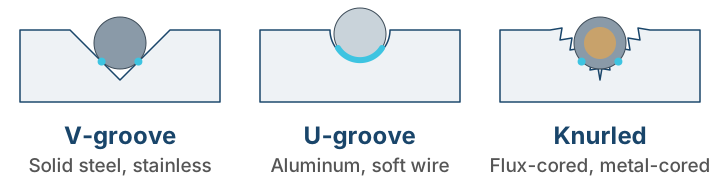
Drive rolls grip the wire and push it through the liner, torch, and contact tip on every feed cycle. The groove profile has to match the wire, since a mismatch either fails to grip or damages the wire on every pass.
V-groove rolls suit hardwire, steel and stainless, where the groove’s edge grips without deforming a wire hard enough to hold its shape under pressure.
U-groove rolls suit soft wire, aluminum in particular, where a rounded profile spreads contact pressure across a wider area. A V-groove’s edge grip would shave or flatten aluminum the same way a rigid conduit or liner wall does.
Knurled rolls suit flux-cored and metal-cored wire, where a textured surface grips a wire whose outer surface isn’t as uniform as solid wire, without crushing the tube wall a smooth groove might slip against.
Tension calibration and failure symptoms
Correct tension feeds wire smoothly under load, with at most a slight, even deformation where the rolls contact the wire. There’s no single tension figure that applies across feeders and wire types, since it depends on the equipment, so a feeder’s own documentation is the starting reference, verified against the wire’s condition after a test feed.
Two failure directions from there, both producing feed problems with different signatures:
Excessive tension flattens or visibly scores the wire and accelerates roll wear. Over time, this shows up as feed inconsistency even at the original tension setting, since the rolls themselves have worn.
Insufficient tension lets the wire slip under load. The symptom is feed speed that surges and lags rather than holding a consistent rate, which shows up in the arc as instability even though nothing about the wire itself has changed.
Is this a drive roll problem, or something else
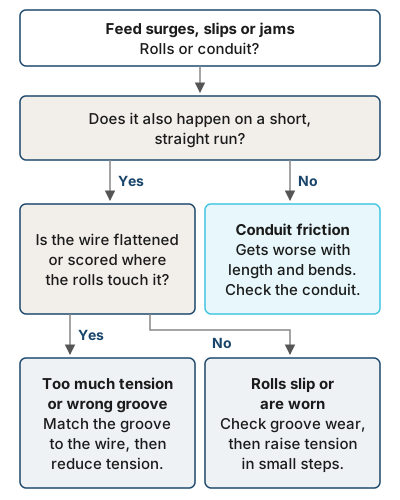
Start with run length. Drive roll tension and wear don’t depend on distance, so a symptom that shows up the same way on a short, straight setup points at the rolls. Flattened, scored or crushed wire at the contact points means too much tension or the wrong groove for the wire. If the wire looks clean, check the groove for wear. Wear builds up over a roll’s service life even at correct tension, so rolls that have run a high duty cycle are worth checking whenever the problem started.
If the symptom tracks with run length instead, why your MIG wire feed keeps jamming sorts the remaining root causes and routes to the right fix.
Why conduit resistance matters to drive roll load
Drive rolls compensate for whatever resistance sits between the pay-off pack and the feeder. A conventional sliding liner accumulates resistance with length, bend count, and wire type, and the drive rolls have to work harder to push wire through that resistance on every cycle, which is a mechanical load the rolls weren’t sized to carry indefinitely. A conduit built on rolling contact instead of a sliding liner, such as Rolliner 3G with its published coefficient of friction of 0.08, changes the resistance the drive rolls are compensating for in the first place. Less upstream resistance means less load on the rolls over the life of the line. How much wear that saves on a given setup hasn’t been measured independently, so we don’t put a number on it. Welding wire conduit systems covers the mechanism and the full spec sheet.
Featured Hardware
Rolliner 3G
Resistance upstream of the feeder wearing your drive rolls faster than it should? Ask about Rolliner 3G.
Get a quote →Want to distribute Rolliner in the US?
Become a reseller →Frequently Asked Questions
What's the difference between V-groove and U-groove drive rolls?
V-groove rolls grip hardwire, steel and stainless, using the groove's edge, which doesn't deform a hard wire's surface. U-groove rolls have a rounded profile that spreads contact pressure across a wider area, which soft wire like aluminum needs to avoid shaving or flattening under the same grip force a V-groove would apply.
How do I know if my drive roll tension is set correctly?
Correct tension feeds wire smoothly under load with at most a slight, even deformation. Excessive tension flattens or scores the wire visibly and accelerates roll wear. Insufficient tension lets the wire slip under load, which shows up as feed speed that surges and lags rather than holding steady. There's no universal PSI or turn-count that applies across wire types and feeders, since it varies by equipment. Check the feeder's documentation for a starting point, then verify against the wire's condition after a test feed.
Can worn drive rolls cause the same symptoms as a conduit problem?
The symptom, inconsistent feed or jamming, can look similar from the operator's chair, but the pattern differs. Worn drive rolls produce inconsistent feed on short, straight setups the same as long ones, since roll wear isn't a distance-dependent mechanism. A symptom that only appears or worsens on longer or more bent runs points instead at conduit friction, not the drive rolls.
Does a lower-friction conduit reduce drive roll wear?
In principle, yes. Drive rolls compensate for whatever resistance sits upstream of them, so less upstream resistance means less work for the rolls over the life of a line. No independent study has measured the size of that effect yet, so we can't give a wear-reduction figure.